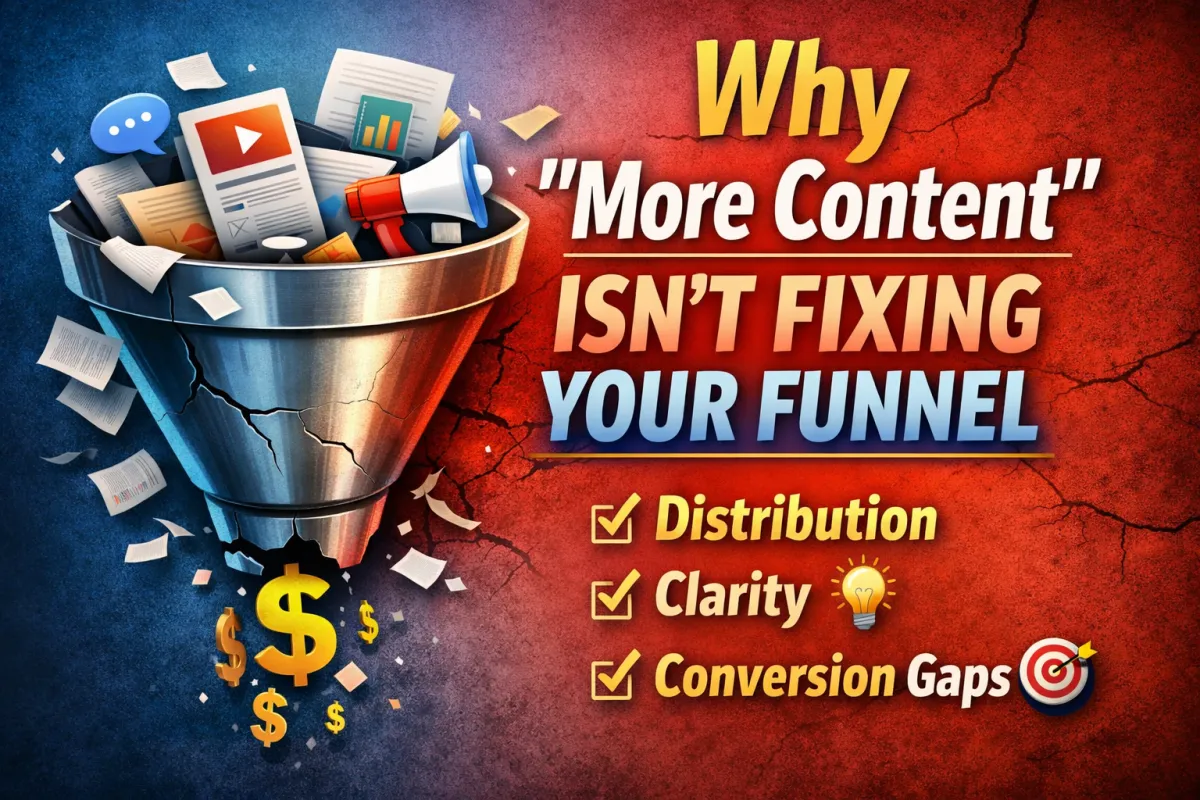
Why "More Content" Isn't Fixing Your Funnel
Spoiler: your problem isn’t volume—it’s distribution, clarity, and conversion.
Let’s start with a familiar scene.
Your marketing team just shipped another blog post.
Your social calendar is full.
Your CRM says content touches are up.
Your CEO asks, “So… why isn’t pipeline moving?”
Cue the reflex response:
“We probably just need more content.”
No.
You don’t.
If more content actually fixed funnels, every brand with a blog would be thriving—and we wouldn’t all be doom-scrolling through half-baked thought leadership on LinkedIn.
The uncomfortable truth?
Most funnels don’t fail because they lack content. They fail because:
The content isn’t seen (distribution problem)
The message isn’t clear (clarity problem)
The content doesn’t convert (conversion problem)
Let’s break down why “just create more” is the most expensive lie in modern marketing—and what actually moves revenue.
The Content Delusion: Activity ≠ Impact
Somewhere along the way, content marketing turned into a productivity contest.
Weekly blogs
Daily social posts
Monthly lead magnets
Quarterly whitepapers no one reads
Marketing teams stay busy. Dashboards look active. But growth stays flat.
Why?
Because content is only valuable if it changes behavior.
Publishing without distribution is like printing flyers and leaving them in a box.
Publishing without clarity is like yelling through a megaphone with no message.
Publishing without conversion is like inviting people to a party and forgetting to give them the address.
Let’s talk about the real gaps.
Gap #1: You Don’t Have a Content Problem—You Have a Distribution Problem
Here’s a stat that should haunt every marketer:
The average organic reach of a social post is less than 5%.
That means 95% of the content you’re creating is invisible by default.
Yet most teams spend:
80% of their time creating content
20% of their time distributing it (if that)
Backwards.
Content doesn’t spread itself anymore
Organic distribution used to be the reward for consistency. Now it’s a lottery ticket.
If your distribution plan is:
“We’ll post it on LinkedIn”
“We’ll add it to the blog”
“We’ll send it in the newsletter”
…you don’t have a distribution strategy. You have a hope strategy.
High-performing funnels obsess over where content shows up
Strong content engines ask:
Who exactly needs to see this?
Where do they already spend attention?
How many times does this need to show up before it’s remembered?
Is this content being repurposed or one-and-done?
One great idea should become:
A blog post
3–5 social posts
A short email
A sales enablement asset
A talking point for SDRs
If your content lifecycle ends at “Publish,” the funnel breaks immediately.
Gap #2: Your Content Lacks Clarity (Because You’re Trying to Say Too Much)
Most content doesn’t fail because it’s bad.
It fails because it’s vague.
You’ve seen it:
“Helping businesses grow with innovative solutions”
“Your partner in digital transformation”
“Thought leadership on modern marketing”
That’s not positioning. That’s filler.
Clarity beats cleverness every time
If someone can’t answer these questions within 10 seconds, your content won’t work:
Who is this for?
What problem does this solve?
Why should I care right now?
What should I do next?
Too many funnels are built on content that educates but never directs.
Education without direction creates interest.
Direction creates pipeline.
The curse of “content for everyone”
Trying to speak to:
SMBs and enterprises
Owners and practitioners
Beginners and experts
…means you resonate with no one.
High-performing funnels use fewer messages, not more:
One core problem
One clear point of view
One defined audience
One next step
Clarity scales. Confusion compounds.
Gap #3: Your Funnel Has a Conversion Gap (a.k.a. “Now What?”)
Let’s say someone actually:
Finds your content
Reads it
Agrees with it
Then what?
This is where most funnels quietly die.
Content without a next step is a dead end
If the only CTA is:
“Contact us”
“Learn more”
“Book a demo”
…you’re asking for a leap most buyers aren’t ready to take.
Content should progress commitment, not demand it.
Think in steps:
Awareness → understanding
Understanding → trust
Trust → action
Your CTAs should match intent:
Early-stage: subscribe, follow, download, watch
Mid-stage: assess, compare, audit, explore
Late-stage: book, buy, implement
If everything points straight to “Book a Call,” you’re forcing conversion before confidence exists.
That’s not bold. That’s lazy.
Why Funnels Stall Even When Content Is “Working”
Here’s the most frustrating scenario:
Traffic is up
Engagement looks healthy
Leads are inconsistent
What’s happening?
Your funnel likely has micro-friction:
Content topics don’t align with your actual offer
Messaging changes from channel to channel
Sales conversations don’t reflect marketing language
CTAs feel disconnected from the content promise
Funnels don’t break in obvious ways.
They leak quietly.
The fix isn’t more content.
It’s alignment.
What Actually Fixes Funnels (Hint: It’s Less Content, Used Better)
If you want content to drive growth, shift your mindset from publishing to orchestration.
1. Start with the funnel, not the content calendar
Before you create anything, ask:
What stage of the funnel does this serve?
What question is this answering?
What action should follow?
Content is a means, not the strategy.
2. Build around a small number of core ideas
Most brands don’t need 100 topics.
They need 5 ideas said consistently.
Repetition builds memory.
Memory builds trust.
Trust builds revenue.
3. Design content with distribution baked in
If you don’t know how something will be:
Repurposed
Promoted
Reused by sales
…don’t create it yet.
4. Measure what matters (not vanity metrics)
Pageviews don’t equal pipeline.
Likes don’t equal intent.
Better signals:
Time on content
Return visits
CTA progression
Assisted conversions
Sales feedback loops
If content isn’t helping sales conversations, it’s noise.
The Hard Truth (and the Opportunity)
“More content” feels productive.
It feels safe.
It feels measurable.
But growth doesn’t come from volume.
It comes from focus.
The brands winning right now aren’t louder.
They’re clearer.
They show up in the right places.
They guide buyers instead of overwhelming them.
If your funnel isn’t working, don’t ask:
“What should we create next?”
Ask:
Who isn’t seeing this?
What’s confusing here?
Where are we losing momentum?
What’s the smallest next step we can ask for?
That’s how content turns into conversion.
A Soft Nudge (Not a Hard Sell)
If this article sounds uncomfortably familiar, it’s usually because your marketing systems are fragmented—not because your team isn’t working hard.
Funnels work best when:
Content, distribution, and conversion live in one place
Messaging stays consistent across channels
You can actually see what’s influencing revenue
That’s the gap platforms like MktrHub are designed to close—connecting content, CRM, automation, and reporting so your funnel stops leaking and starts learning.
No more “just publish more.”
Just smarter, clearer growth.
